The golf industry generates more than $100 billion in economic impact every year. However, many golf courses still struggle to consistently fill their tee sheet, attract new players, and increase customer retention.
The difference between a golf course that grows and one that simply maintains its current level of activity often comes down to how it executes its marketing strategy.
For years, maintaining fast greens, well-kept fairways, and a strong Clubhouse experience could be enough to attract players. Today, that is no longer the case.
Golf course operators compete with new leisure options, changing consumer habits, and golfers who expect simple online booking processes, personalized communication, and seamless digital experiences.
That is why marketing for golf courses must combine business knowledge, technology, data analysis, and a deep understanding of player behavior.
This guide brings together 25 golf course marketing ideas designed to help private clubs, public courses, resorts, and academies increase bookings, retain players, improve tee sheet occupancy, and generate more revenue throughout the season.
Digital marketing foundations for golf courses
1. Optimize your website to turn visitors into bookings
A golf course website is much more than a brochure. It is the main digital touchpoint between the player and the facility.
When a golfer visits your website, they are usually looking for specific information: rates, availability, location, course features, clubhouse services, or tee time booking. If finding that information is difficult, they are likely to leave the site and book at another course.
An effective website should load quickly, be mobile-friendly, and clearly display the online booking engine. It should also include real photos of the course, the most representative holes, practice areas, restaurant, pro shop, and event facilities.
Pages dedicated to memberships, tournaments, lessons, corporate events, and weddings should be written with a clear objective: to explain the value of the experience and make it easy to enquire or book.
2. Work on local SEO to appear in nearby golf searches
Local SEO is essential for any golf course that wants to attract players within its surrounding area.
When a user searches for “golf course near me,” “book tee time in Madrid,” or “golf club for corporate events,” Google needs to understand that your facility is a relevant option.
To achieve this, it is important to optimize your Google Business Profile with updated opening hours, address, phone number, recent photos, booking links, and frequent posts.
Remember that Golfmanager is one of the few software platforms in the world that enables the booking button on the business listing thanks to our integration with Google.
Reviews are also essential. A course with positive reviews, professional responses, and consistent activity builds trust with both search engines and future players.
In addition, your website should include content related to the course location, the type of layout, the services available, and the experiences it offers. Talking about local tournaments, corporate golf, golf breaks, or plans for visiting players helps strengthen the club’s relevance in local searches.
3. Use email marketing to increase repeat play
Email marketing remains one of the most profitable channels for golf courses because it allows direct communication with players, members, and past customers.
The key is not to send the same message to the entire database. A regular member, an occasional player, a corporate client, and an academy student all have different interests.
A good email marketing system allows segmentation by playing frequency, customer type, preferred tee times, average spend, tournament participation, or booking history. With this information, the course can send more relevant communications: tee time availability, twilight promotions, upcoming tournaments, membership renewal campaigns, or content from the club professional.
Email is also useful for keeping the relationship with the player alive after the round, thanking them for their visit, requesting a review, or recommending a new booking.
4. Turn social media into a showcase for the club experience
Golf is a visual sport. A sunrise over the green, a signature hole, a full terrace after a round, or a well-organized tournament can communicate more than any promotional copy.
Instagram, Facebook, LinkedIn, and TikTok allow you to show the real experience of playing at your course. Instagram works especially well for showcasing the course, the condition of the course, and aspirational moments. Facebook helps communicate tournaments, events, and club news. LinkedIn is useful for promoting corporate events, business meetings, and networking experiences in a golf setting.
Social media should not be limited to posting offers. It should build community. Showing members, players, staff, tournaments, greenkeepers, and everyday moments helps humanize the club’s brand.
User-generated content is also highly valuable. When a player shares a photo or video at your course, they are organically recommending the experience.
5. Implement dynamic pricing to optimize the tee sheet
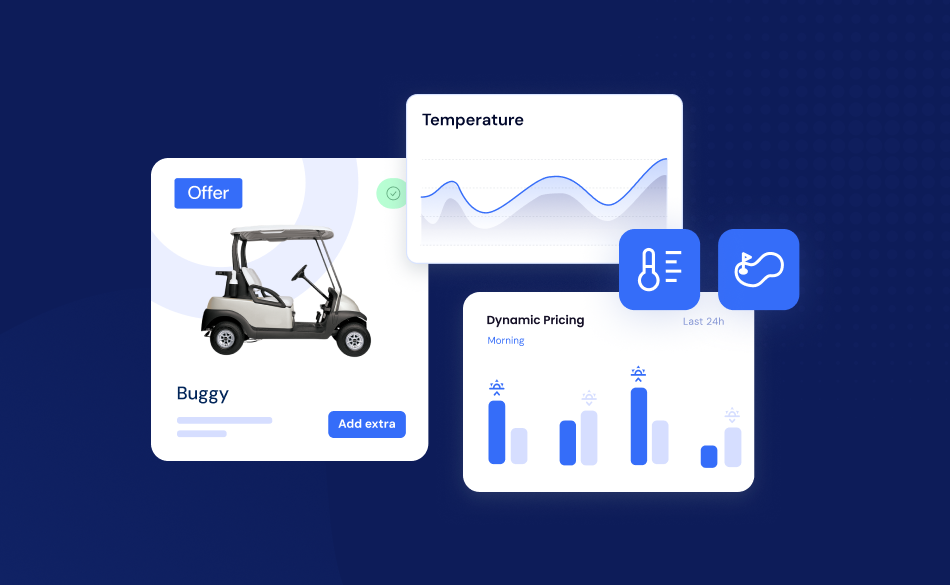
Dynamic pricing allows rates to be adjusted according to demand, time slot, day of the week, season, and booking window.
At a golf course, not every tee time has the same value. A Saturday morning tee time in peak season should not be priced the same as a weekday twilight round. Applying differentiated pricing helps maximize revenue during high-demand hours and improve occupancy in less popular time slots.
Last-minute promotions can help fill unexpected gaps, while early booking discounts provide revenue predictability. Multi-round vouchers, season passes, or flexible packages can also be used to encourage repeat play.
Event-based marketing strategies
6. Organize tournaments to attract players and generate additional revenue
Tournaments are one of the most powerful marketing tools for a golf course. They generate activity, attract new players, increase food and beverage spend, and create sponsorship opportunities.
A balanced calendar can include social tournaments, charity competitions, corporate scrambles, weekly leagues, club championships, and themed events. Each format attracts a different type of player.
Charity tournaments, for example, connect the club with the community and make it easier for corporate sponsors to participate. Scrambles are ideal for players of different skill levels, as they encourage participation without requiring a highly competitive standard.
7. Create annual events that become traditions
The best-positioned golf courses often have events that players look forward to every year.
A season-opening tournament, a summer cup, a club championship, or an annual closing event can become important fixtures in the club calendar.
The key is to build a narrative around the event. It is not just about organizing a competition, but about creating a memorable experience with pre-event communication, sponsors, prizes, photography, food and beverage, and post-event follow-up.
When an event is repeated every year and improves with each edition, it becomes a tool for loyalty and reputation.
8. Collaborate with local businesses to expand your reach
A golf course can generate more visibility when it becomes part of the local business ecosystem.
Partnerships with hotels make it possible to create golf and accommodation packages. Collaborations with restaurants, wineries, or local brands can enrich social events and tournaments. Agreements with companies can become opportunities for corporate events, business memberships, or team-building activities.
This type of collaboration positions the golf course as a space for leisure, business, and social connection, not just as a sports facility.
9. Develop junior and family programs
Attracting new generations is essential for the future of golf.
Junior programs, children’s golf schools, family clinics, and summer camps help introduce the sport to children and young people. In addition, when a child starts playing golf, the family often becomes involved as well.
Family programs help increase club activity during specific time slots, improve community perception, and build long-term relationships with future members and repeat players.
Technology applied to golf marketing
10. Make online tee time booking easy
Online booking should be fast, intuitive, and accessible from any device.
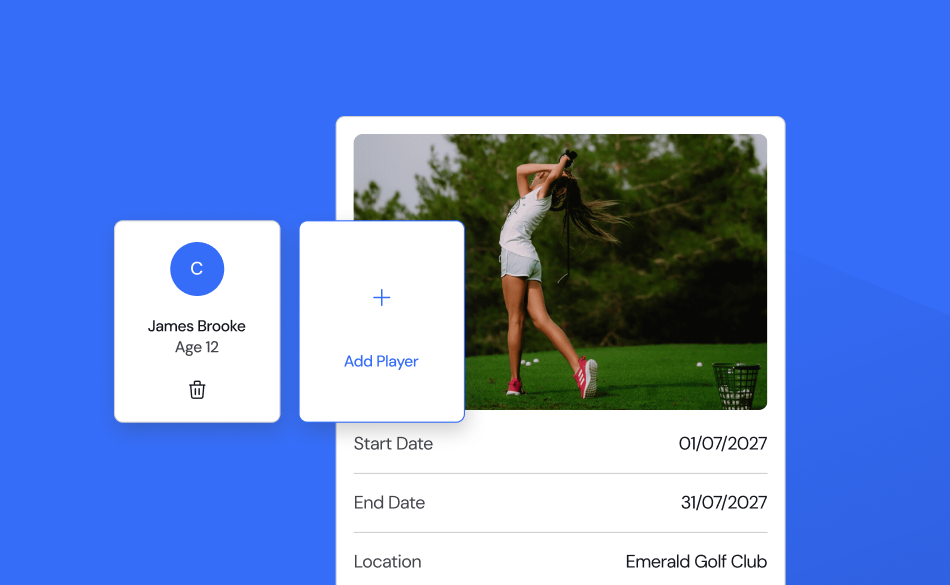
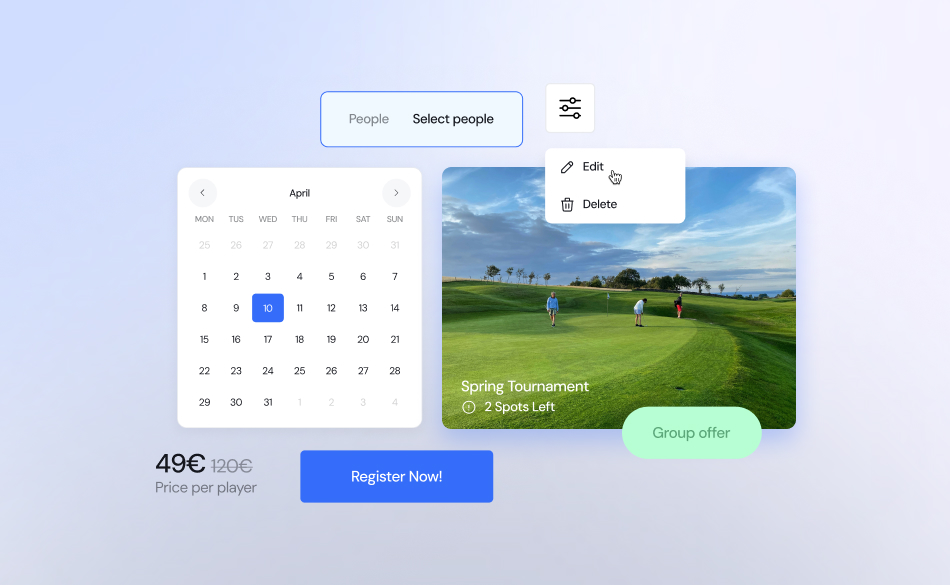
A player should not have to call the club to check availability or confirm a tee time. The system should display real-time availability, allow players to be selected, apply the correct rates, and confirm payment immediately.
The easier the booking experience, the lower the friction and the higher the conversion rate.
11. Launch a mobile app to improve the player experience
A mobile app allows the golf course to be present on the player’s phone before, during, and after the round.
From the app, the player can book tee times, check their history, receive notifications, access promotions, use digital scorecards, or consult course information.
For the operator, the app is a direct communication channel. Push notifications can be used to inform players about last-minute availability, weather-related changes, upcoming tournaments, or exclusive promotions.
12. Use data to personalize marketing campaigns
Data makes it possible to move from generic marketing to much more precise communication.
A golf course can analyze which players book on weekdays, who prefer weekends, which customers participate in tournaments, who spend in the restaurant, or which users have not played for several months.
With this information, the club can create specific campaigns to win back inactive players, promote underused time slots, sell premium packages, or encourage participation in events.
13. Actively manage your online reputation
Online reviews directly influence booking decisions.
Before playing at an unfamiliar course, many golfers check Google, social media, or specialist platforms. A profile with good reviews, current photos, and professional responses builds trust.
It is important to request reviews after positive experiences and always respond constructively. Even a negative review can become an opportunity if the club demonstrates attention, professionalism, and a willingness to improve.
Experience and community as marketing tools
14. Organize events that go beyond golf
A golf course can also be a social, gastronomic, and business venue.
Events such as themed dinners, live music, wine tastings, networking meetings, product presentations, or family celebrations can attract people who may not play golf but can discover the facility.
These events expand the target audience and generate additional revenue in food and beverage, venue hire, and complementary services.
15. Collaborate with golf content creators and influencers
Specialized content creators can help showcase your course to new audiences.
It is not just about inviting someone to play for free, but about designing an experience worth sharing: a signature hole, a round with the club professional, a special challenge, a tournament, or a visit to areas that are not normally visible to the public.
Authentic third-party content often has more credibility than traditional advertising.
16. Turn your members into club ambassadors
Members and regular players are one of the most valuable marketing assets a golf course has.
An ambassador or referral program can encourage them to recommend the club to friends, family, or colleagues. Rewards can include guest green fees, pro shop credit, tournament discounts, or exclusive benefits.
When a recommendation comes from a satisfied player, the level of trust is much higher than in any paid campaign.
Promotions and loyalty
17. Design campaigns adapted to each season
Golf course marketing should change depending on the time of year.
Spring can focus on the start of the season, membership sales, and player reactivation. Summer can focus on tourism, families, and twilight tee times. Autumn is often a great opportunity to promote ideal playing conditions. Winter can be used to sell vouchers, gift experiences, simulators, or indoor events, depending on the climate in each region.
Adapting the message to the season improves campaign relevance.
18. Create attractive commercial packages
Packages help increase the average ticket and make the purchasing decision easier.
A golf and restaurant package can improve the post-round experience. A golf and hotel package can attract tourism. A corporate package with green fee, food, drinks, prizes, and full organization makes it easier to sell to companies.
The goal is to sell a complete experience, not just a round of golf.
19. Implement loyalty programs
Retaining a player is often more profitable than acquiring a new one.
Loyalty programs can be based on points, rewards, tiered benefits, or play vouchers. What matters is that the player perceives value in returning.
A digital platform makes it possible to automate this process, record activity, activate rewards, and communicate benefits in a personalized way.
20. Offer more flexible membership models
Traditional annual membership does not fit every player profile.
Many golfers are looking for more flexible options, such as weekday memberships, season passes, young professional memberships, corporate plans, or hybrid models that combine member benefits with pay-per-use.
Offering alternatives expands the potential market without necessarily compromising the value of the main membership.
Content marketing for golf courses
21. Maintain a blog with useful content for players and companies
A well-developed blog helps position the course website in search engines and in AI-generated answers.
Content should answer real questions from the target audience. For example, how to choose a course for a corporate event, what to consider when organizing a tournament, how to improve the pace of play, what benefits a membership offers, or why players should book directly through the club’s website.
It is also advisable to publish content about the course itself: hole guides, tips from the professional, interviews with the greenkeeper, tournament calendar, or facility improvements.
22. Produce video content to show the real experience
Video can convey feelings and atmosphere that text cannot fully explain.
Hole flyovers, virtual tours, short videos showing course conditions, technical tips from the professional, and tournament highlights help show the club’s personality.
This content can be used on the website, social media, email campaigns, and event pages.
23. Tell the story and identity of your course
Every golf course has its own history, design, community, and personality.
Telling that story helps create differentiation. It can include the club’s origins, the course architect, important sporting moments, the evolution of the layout, sustainability commitments, or testimonials from long-standing members.
Players do not choose a course only because of price or location. They also choose places they feel connected to.
Advanced strategies to increase revenue
24. Promote the restaurant and Food & Beverage services
Food and beverage is an important source of revenue that is often not used enough in marketing.
The club restaurant can attract both players and non-golfers. Special menus, after-golf experiences, weekend brunch, gastronomic events, or terraces overlooking the course can become strong commercial arguments.
In addition, integrating food and beverage with golf through packages, tournaments, or corporate events increases the average spend per customer.
25. Integrate marketing, operations, and data into a single platform
To execute a modern marketing strategy, the golf course needs connected technology.
The tee sheet, CRM, booking engine, POS, event management, email marketing, mobile app, and reports must work together. When these systems are disconnected, data is lost, tasks are duplicated, and the customer experience suffers.
An all-in-one platform allows operators to better understand the player, automate communications, personalize campaigns, measure results, and make decisions based on real data.
How to measure marketing success at a golf course
A marketing strategy only works if it can be measured.
The most important indicators for a golf course are not just social media followers or website visits. What truly matters is how those actions translate into bookings, revenue, and loyalty.
It is useful to analyze tee sheet occupancy, average revenue per player, online bookings, campaign conversion, tournament participation, customer retention, food and beverage spend, and player lifetime value.
Measuring this data makes it possible to identify which campaigns generate results, which segments are most profitable, and where there are opportunities to increase revenue.
The future of marketing for golf courses
The golf courses that grow in the coming years will be those that understand marketing as a strategic part of management.
Course quality, customer service, and maintenance will remain essential, but they are no longer enough on their own. Today’s player expects easy booking, relevant communication, personalized experiences, and a smooth digital relationship with the club.
Operators that combine operational excellence, integrated technology, data, content, and community will be better positioned to fill their tee sheet, increase loyalty, and compete in an increasingly demanding market.
Power your golf course marketing with Golfmanager
Golfmanager helps golf courses, clubs, and resorts centralize their operations, automate processes, and improve the digital experience for their players.
With an all-in-one platform that connects online booking, tee sheet, CRM, email marketing, event management, POS, mobile app, and reporting, operators can run more effective campaigns, reduce manual tasks, and make better commercial decisions.
If you want to transform the way you market your golf course and increase bookings with technology designed specifically for the golf industry, request a demo with our team.